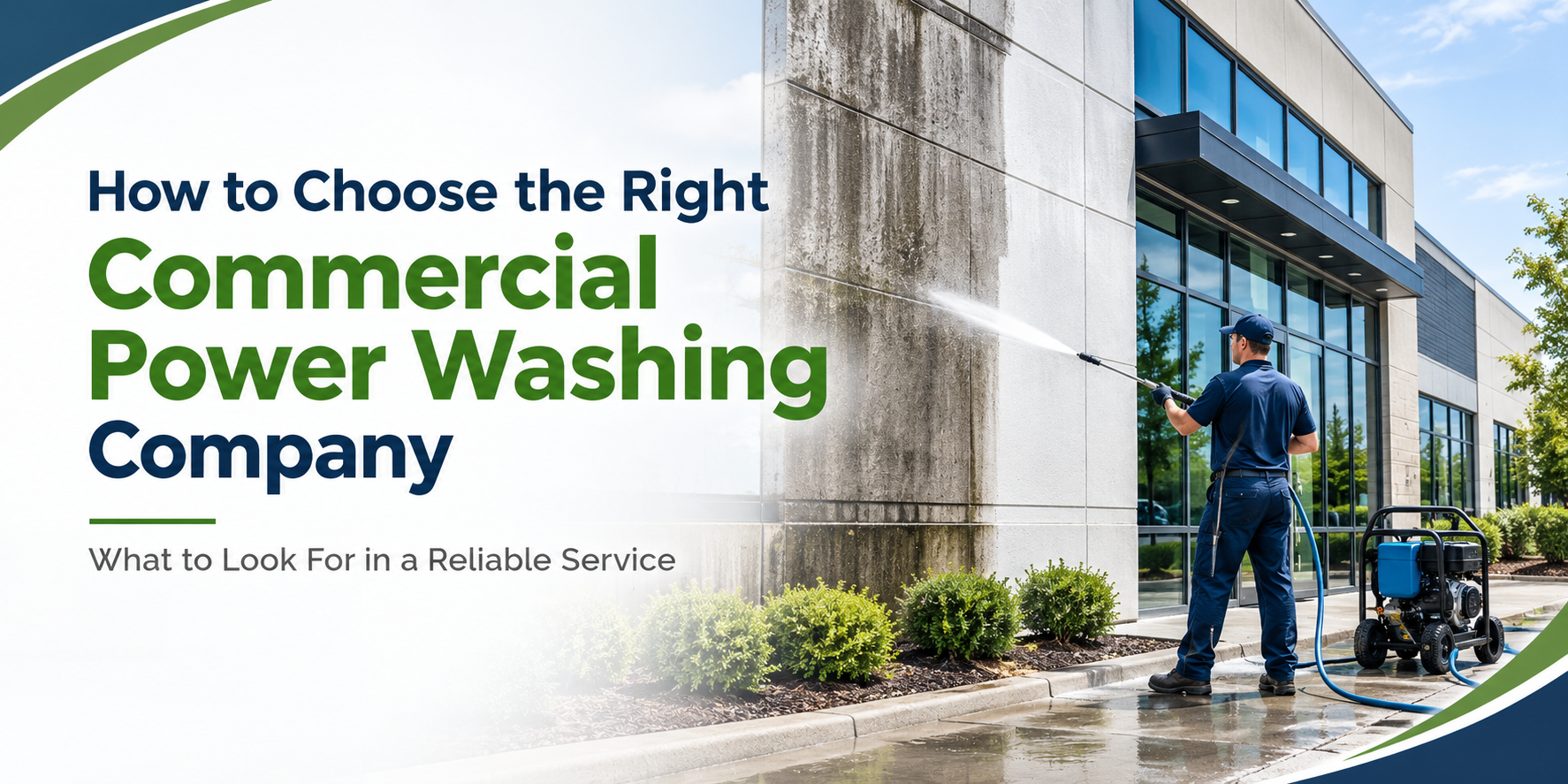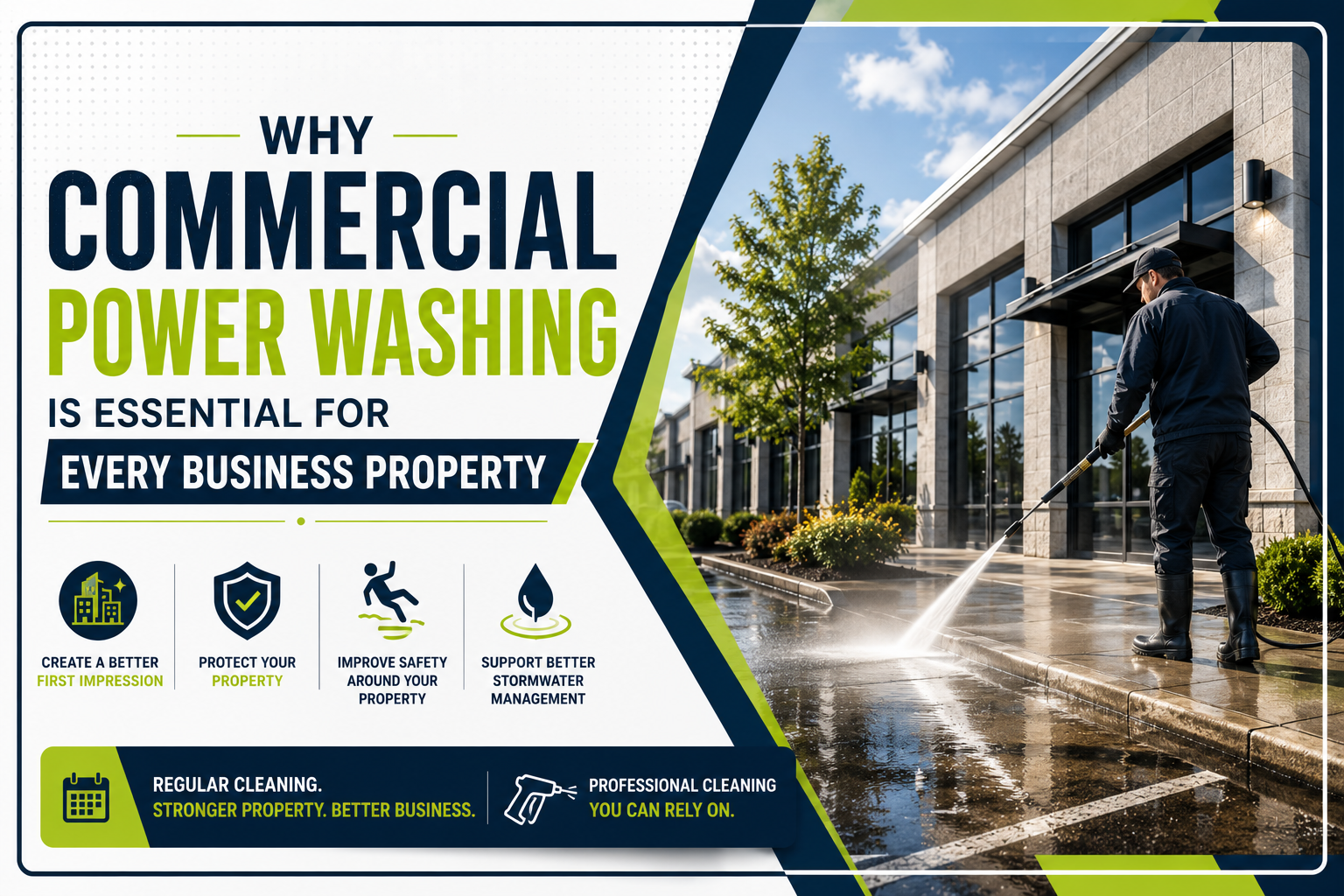
A commercial building may get dirty because of different reasons. For example, concrete can get stained by oil from vehicles, tire marks and winter salt whereas the siding can grow algae, mildew or develop staining.
To get the best results from a commercial building cleaning, you need to use the suitable cleaning method. Commercial power washing is ideal for surfaces that are strong enough to withstand the impact of high pressure water whereas soft washing which is gentle with lower water pressure coupled with cleaning chemicals is suitable for softer materials.
Actually, what the building is made of matters more in choosing the right cleaning method than just how dirty the building appears in fact.
What Is Commercial Power Washing
Commercial power washing involves the use of high pressure water to remove dirt, grime, stains and other types of build up on hard outside surfaces. When the materials permit, the water pressure helps the water to lift the dirt which the simple rinsing can’t remove efficiently.
Concrete walking paths, parking lots, trucking zones, and some stone surfaces are typical applications. Hot water can be extremely effective if a property has been contaminated with a substance like, for example, oil or gum, since high temperature can help break down the substance more efficiently.
Imagine a restaurant’s landfill area being power washed in the same way as its exterior walls. It wouldn’t really make sense because they are very different surfaces and may require different amounts of pressure.
Professional cleaning needs to look out for runoff problems as well. According to the U. S. Environmental Protection Agency, stormwater is a good vehicle for sediment, oil, and grease from hard surfaces. Because of that, cleaning should take great care of determining where and how the runoff water goes and not just let it flow down to the nearest storm drain.
What Is Soft Washing
Soft washing is done differently. There is no excessive reliance of high pressure alone in this method. Rather, the water with low pressure is mixed together with specially selected cleaning solutions which can effectively breakdown organic growth and remove surface contamination.
This type of method tends to be safe for different kinds of materials including painted siding, stucco, rooves and other exterior surfaces that are susceptible to getting damaged by strong pressure.
This discrepancy is significant, as excessive pressure can strip paint or damage finishes, or even force water into places where it should not be able to go. According to the service information by Forest City Power Washing, gentle surfaces are best treated by using low-pressure soft washing, and materials that are tougher like concrete and brick should be subjected to high-pressure jets.
So, soft washing might be the more preferable method in most instances where algae, mold, and other similar kinds of biological growth are the primary factors.
Power Washing vs. Soft Washing at a Glance
| Factor | Commercial Power Washing | Soft Washing |
| Main cleaning action | Pressurized water | Cleaning solution and low-pressure rinsing |
| Best suited for | Concrete, parking areas and durable masonry | Siding, stucco, painted surfaces and delicate materials |
| Common buildup | Dirt, grease, oil, tire marks and grime | Algae, mildew, mold and organic growth |
| Pressure | Higher | Lower |
| Main concern | Avoiding surface damage from excessive pressure | Using the correct solution and application |
| Typical commercial use | Sidewalks, parking areas, loading zones | Building exteriors and delicate cladding |
The table is a starting point, not a substitute for assessing the actual condition and material of a building.
Which Cleaning Method Does Your Commercial Building Need
Power Washing for Hard Surfaces
To effectively restore the cleanliness of surfaces that can withstand pressure and where mechanical power is needed to lift stains, power washing is highly suitable. Concrete walkways, parking areas and other hard surfaces are good candidates.
Locations that are often covered with heavy foot or vehicle traffic have to be cleaned much more frequently than those that get little attention. Dirt and other pollutants tend to collect on entrances, sidewalks, loading zones and parking spaces much quicker than on less-used areas. Oil and road grime, besides being visually unappealing when a place is frequently visited, become quite evident when it’s very cold, and vehicles are kept indoors.
Soft Washing for Delicate Exterior Surfaces
If a surface can be ruined by powerful pressure from a nozzle, soft washing is a much better approach. Soft washing helps to clean delicate surfaces like painted siding, stucco, and similar surfaces by a light mechanical action, without the aggressive power of a high-pressure spray.
The effectiveness of softwashing is also in its approach to cleaning up a problem of biological growth, which in most cases are algae, mold, etc. That is to say instead of merely physically removing the dirt, soft washing combines the use of environmentally friendly cleaning agents that penetrate and remove the roots, so to speak, of the growth before the surface is given its final rinse.
Combine Power and Soft Washing for Bigger Properties
Many industrial/commercial buildings don’t need to stick to one washing technique all the way from roof to ground.
A property manager could use soft washing technique on the building’s exterior and power washing for the concrete sidewalks. A restaurant may want subtle exterior cleaning around the walls and use stronger methods on hard surfaces suitable next to the service areas
Power vs soft is washing doesn’t have to be a black and white decision all of the time. With a well-thought-out cleaning plan, different areas could be cleaned with either method.
Why the Right Method Matters for Commercial Property Cleaning
Correct method selection plays a significant role in preserving the looks and integrity of the building’s external surfaces, while minimizing the unnecessary deterioration of the material through over-usage.
Besides that, it can make maintenance work more efficient. With scheduled property checks, one can be able to know high-traffic or heavily contaminated areas before any deposit is a permanent mess.
We should equally consider safety. Falls have killed 844 people at workplaces in U.S. in the calendar year 2024 together with almost a quarter of a million severe injuries resulting in job absence.
Exterior cleaning on its own cannot resolve slip hazards but doing away with certain accumulations from the walkways along with the other areas of the building can form part of the property maintenance regimen.
Forest City Power Washing also points out that the time interval between consecutive cleaning varies largely and is affected by things like the type of property, the level of traffic, weather conditions, the material surfaces and the type of seasonal deposit.
How Often Should Commercial Buildings Be Cleaned
No one schedule is suitable for all businesses.
A highly occupied retail location needs to be maintained and kept in a good condition around the entryways and sidewalks more frequently compared to an office space which is hardly ever visited.
Rewards and services of cleaning businesses can be very different if the client is a restaurant, warehouse or any building that is in the vicinity of a lot of trees.
A good idea is to regularly check the property and spot for these things:
- Black or green biological growths
- Grease and oil spills
- Dirty and muddy steps
- Grease- covered concrete
- Water-algae on outer walls
- A mess of old stuff near dumpsters
- Salt marks and leftovers from winters.
Forest City Power Washing’s current commercial recommendations mention that the majority of commercial sites might need to have them cleaned from one to four times yearly based on circumstances and the way the facility is used.
For additional maintenance guidance, see The Complete Guide to Commercial Power Washing.
Make the Cleaning Method Fit the Building
Cleaning exterior surfaces commercially gets the best results, if the method is chosen according to the material rather than forcing material to adapt to the method. For example, hard surfaces might get good results with the control of the pressure, while it’s often a low-pressure approach that is needed for delicate surfaces and materials.
The main point of business owners and property managers is removing the dirt and buildup not introducing new surface problems. Through proper evaluation, the cleaning itself gets scheduled as a maintenance element of property instead of a sudden action only when the outside becomes impossible to clean anymore.
Frequently Asked Questions
Is commercial power washing the same as soft washing?
No. Power washing generally relies on stronger water pressure for durable surfaces, while soft washing uses low pressure with cleaning solutions for more delicate materials.
Can soft washing clean a commercial building exterior?
Yes. Soft washing can be suitable for surfaces such as siding, stucco and painted exterior materials where high pressure may cause damage.
Is power washing safe for concrete?
Concrete is generally more capable of handling pressure than delicate siding or painted surfaces. However, pressure, nozzle selection and technique still need to match the condition of the concrete.
How often should a commercial property be power washed?
It depends on traffic, climate, surface materials, surrounding vegetation and the type of contaminants present. Some properties may benefit from several cleanings per year, while others may need less frequent service.
Which method is better for a commercial building?
Neither method is automatically better. The correct choice depends on the material and the type of buildup. A property may need power washing for hard surfaces and soft washing for delicate exterior areas.